Outgoing
Currently, recruitment for the Erasmus+ programme is not open. The next call for applications for mobility in the academic year 2026/2027 will be announced in June. Information about the recruitment will be published on the university’s website and social media channels, and will also be sent to students’ email addresses.
Welcome to the Outgoing section of Erasmus+! Here you will find all the information you need about studying or doing traineeship abroad as part of the Erasmus+ program. This section will guide you through the application process, available destinations, and practical tips to help you prepare for your mobility experience. Take the opportunity to enhance your skills and explore new cultures with Erasmus+!
Erasmus code: PL DABROWA 01
Contact details of International Cooperation Office:

Gabriela Węglarz - Dąbrowa Górnicza Campus
Academic Mobility Coordinator
International Office – Room 206
Tel: 32 295 93 16
E-mail: gweglarz@wsb.edu.pl

Marta Masłyk - Dąbrowa Górnicza Campus
International Cooperation & Promotion Specialist
International Office – Room 206
Tel: 32 295 93 16
E-mail: mmaslyk@wsb.edu.pl

Katarzyna Gajewska, PhD - Warsaw Campus
Vice-Rector, WSB University – Warsaw
Palace of Culture and Science, 8th floor
tel. +48 22 656 62 56
tel. +48 608 670 533
katarzyna.gajewska@wsb.edu.pl
-

In the case of selection, please make sure to review the Erasmus Charter for Students and follow the steps outlined below.
Duration of mobility
- A long-term study mobility can last from a minimum of 2 months up to a maximum of 12 months.
- A short-term study mobility (i.e. BIP) can last from a minimum of 5 to a maximum of 30 days.
- A traineeship mobility can last from a minimum of 2 months up to a maximum of 12 months.
Whether you're a student or trainee, you can benefit from Erasmus+ exchanges multiple times. Keep in mind that your total time abroad, including study periods, shouldn't exceed 12 months within one study cycle.
In the case of students transferring to study at WSB University from another university who have made mobility within the framework of the Erasmus+ program in the previous university, mobility periods accumulate.
Alumni traineeship mobility
The traineeship is dedicated for recent graduates who applied for mobility as students before BA/MA defense.
- The application is valid for 12 months from the date of defense.
- The Learning Agreement must be signed and approved by all parties before your thesis defense.
Alumni mobility cannot be combined with traineeship mobility. This means that if you are completing a traineeship during your final semester and wish to extend it after graduation, it will not be possible under the same program. Alumni mobility is a separate category with its own requirements and a different set of documents.
Destination of mobility
Study mobility can be done only in one of the WSBU partner universities listed below:
Traineeship mobility can be done in a company/institution of your choice located in EU member country and third countries associated to the program.
Erasmus+ traineeship cannot be realized in:
• EU institutions,
• managing authorities of EU programmes,
• diplomatic missions in the student's home country.- The scholarship under the Erasmus+ program is of a co-financing nature, so it does not have to cover the full costs associated with the mobility.
- The Erasmus experience focuses on the diversifying the students' life. In such, the students from the same language region are not advised to proceed with their Erasmus+ mobility in the country of similar background.
-
Information about the recruitment is sent to students via email, published on the WSB University website and social media.
Students from WSB University who meet the following criteria can apply for a study or traineeship abroad through the Erasmus+ program:
- Are enrolled in first or second-cycle studies, long-cycle master's programs, or are participants in doctoral studies;
- At the time of application, are at least in the second semester of their first or second cycle studies;
- Possess foreign language skills at a level compatible with the requirements of the host institution, according to the terms specified in the agreement;
- Complete and submit the online application form along with the required attachments within the designated deadline and format.
General recruitment rules- Completion of at least 2 semesters of study
Students can take part in Erasmus+ mobility from third semester of Bachelor Studies or second semester of Master Studies at earliest. - Minimum GPA requirement of 4.0
The Dean's Office is responsible for calculating the GPA and forwarding it to the International Cooperation Office. Only students with a GPA of 4.0 or higher will be considered for recruitment. Those who fall below this threshold are automatically disqualified from the selection process. In the case of a low number of applicants with a minimum GPA of 4.0, applications submitted by students with a GPA below 4.0 may be considered and selected. - Proficiency in the language of instruction at a B2 level or higher
Applicants must demonstrate at least a B2 level of proficiency in the language of instruction at the partner university, which is typically English. Students who already possess a valid language certificate at or above this level are exempt from the language proficiency test. Otherwise, they must take the leveling test, which is the second stage of the recruitment process, conducted online via the Moodle platform.
Remarks:
1. International projects and programmes listed in the application must be different from Erasmus+ participation.
2. Priority to complete long term study mobility is given to students who, at the time of application, hold a valid document authorizing them to stay outside the territory of Poland during the mobility period. If a student does not possess a valid visa or TRC (physical card) at the time of application, their application will still be reviewed; however, the mobility can only be granted once a valid document is presented. For traineeships, students without a valid document may be conditionally accepted. If they later provide a valid residence card to the staff responsible for traineeships, their mobility will be granted only if funding is still available.The recruitment procedure consists of two stages:
- Stage 1: Pre-selection of candidates based on formal requirements
- Stage 2: Conducting language tests (if necessary)
- Stage 3: Conducting online interviews
Announcing results
Within 14 days of the completion of the process, the recruitment committee prepares a report on the qualification procedure along with a list of candidates selected for the mobility and waiting list.
Appeal procedure
Each participant has the right to appeal against a recruitment decision within 7 days of its announcement. The request should be addressed to the Vice Rector for International Cooperation, who will consider the appeal within 14 days. The appeal must be submitted in writing. The content of the appeal should include: personal data, reasons for the appeal, indicating the reasons why the decision should be reconsidered, additional documents if they affect the assessment of the application (e.g. certificates, attestations). The Vice Rector may: uphold the decision if there are no grounds to change the eligibility, amend the results of the recruitment if he/she considers that there has been an error or omission of relevant information, carry out an additional assessment of the application, e.g. by extending the composition of the Recruitment Committee.
-
BEFORE MOBILITY
Each selected student must submit the following documents to the International Cooperation Office before departure:
- Letter of acceptance from the host institution
- Learning Agreement / Traineeship Agreement
- Proof of health insurance, insurance against accidents (and in case of traineeship also Civil Liability insurance)
- Bank details form
- In addition, the student is required to submit all documents requested by the host university/institution (e.g., Transcript of Records, Language Certificate)
Insurance
A patient covered by the voluntary health insurance is entitled to healthcare services on the same rights as a person insured by the National Health Fund (NFZ). The lack of health insurance may result in an obligation to cover the full costs of healthcare services in the case of illness or the necessity to receive immediate medical help.
In order to conclude an agreement for voluntary health insurance, you have to visit the relevant NHS Department where you can fill an application for health insurance coverage by the National Health Fund. Within 7 days from the date of signing the agreement, you must visit ZUS (Social Insurance Institution) in order to submit the application for health insurance.
Necessary documents:
- identity document (ID card, passport),
- residence card or a residence permit for a fixed period of time,
- PESEL [National Identification Number],
- University entrance certificate.
Insurance document entitling to healthcare services is the agreement, together with evidence of paid contribution for the previous month, constitute the evidence of insurance for the person with voluntary health insurance and their family members. Please note that a ZUS application form constitutes an integral part of the agreement.
Monthly health contributions paid to ZUS constitute the basis of entitlement to health insurance benefits, in accordance with the voluntary insurance agreement. The monthly rate for foreign students is 55,80 PLN (costs checked in 2025/2026).
More detailed information and application form for the European Health Insurance Card is available here:
EUROPEAN HEALTH INSURANCE CARD
*EHIC/EKUZ Coverage
Eligible Countries: EU member states, EEA (Iceland, Liechtenstein, Norway), and Switzerland. E.g., Norway – Use EHIC/EKUZ for necessary healthcare on the same terms as residents.
Non-EHIC/EKUZ Countries: EHIC/EKUZ is not applicable in countries outside the EU, EEA, and Switzerland. Notable examples include Turkey, where you must obtain private health insurance.
Health insurance is not identical with insurance against accidents. Therefore, a scholarship student must buy additional insurance against accidents. It is also worth taking advantage of the insurance guaranteed by the EURO 26 or ISIC card. More information here:
It is also recommended to buy civil liability insurance. In case of Erasmus mobility for traineeship civil liability insurance is obligatory. The type and number of the insurance policy should be submitted to the International Office before signing the financial agreement.Grant agreement and scholarship transfer
After providing all the necessary documents, the student signs the Grant Agreement. A scholarship is paid on the basis of a contract. The grant is paid in two parts: 80% before going on mobility and 20% respectively after the full set of documents confirming the mobility has been completed.
The tuition fee disconut during study mobility
The tuition fee discount under the Erasmus+ program amounts to 70% of the total tuition fee. The detailed tuition fee is calculated according to the exact dates of mobility.
Individual Plan of Study (IOS) for study/traineeship mobility
By the decision of Vice-Rector, if you are doing a study/traineeship during your academic year you are obliged to apply for an Individual Plan of Study (in pol. IOS - Indywidualna Organizacja Studiów). You can apply for it in International Deans Office at WSB University (Dąbrowa Górnicza or Kraków campus - it depends on which campus you are studying)
- In justification please write that you are participating in a Study/Traineeship under the Erasmus+ Mobility Program.
- Please also remember to write only duration of your Study/Traineeship mobility so you can continue the studies after your arrival.
INDIVIDUAL PLAN OF STUDY - REQUEST TEMPLATE FOR DĄBROWA GÓRNICZA STUDENTS
INDIVIDUAL PLAN OF STUDY - REQUEST TEMPLATE FOR KRAKÓW STUDENTS
Please inform your student advisor that you are participating in the Erasmus+ Mobility program. Provide them with the dates and a copy of your Learning Agreement so they can support you during your time abroad. It’s also a good idea to notify your lecturers to keep them updated.
DURING MOBILITY
As you start your Erasmus+ mobility, there are a only two important steps to follow:
- During your mobility, stay in touch with the Academic Mobility Coordinator and reach out to them with any questions or issues.
- During your mobility, it is possible to extend the duration under the following conditions:
For Studies - If you begin your mobility in the winter semester, you may be able to extend your stay into the summer semester, provided that the university has additional funds available to support the extension.
For Traineeships - Similarly, in the case of traineeships, you can extend your stay for additional months, again depending on the availability of extra funding from the university. - Remember to share your experience! We’d love to see your Erasmus+ journey! Feel free to take photos or videos during your mobility and share them with us, or tag WSB University on social media.
AFTER MOBILITY
After completing the mobility, the participant is required to:
- Provide the Academic Mobility Coordinator with proof of stay, the so-called Confirmation of Mobility (document available in the Downloads section). This document should be printed on the letterhead of the host institution. There is also the possibility of delivering a document prepared on the host institution's template, provided it contains the required information, i.e., the name and surname of the student undertaking the mobility, the dates of mobility, the name and country of the host institution. This document must be signed by the responsible person at the host institution. The International Cooperation Office requires the submission of the original Confirmation of Mobility document within 10 days of completing the mobility.
- Complete the Erasmus+ program survey (within 30 days of completing mobility), which will automatically be sent to the participant's email address directly from the EU system. The title of the email is: Erasmus+ participant report.
-
Individual support for long term mobilities – mobility lasting from 2 to 12 months:
Amount of grant depends on the country where the mobility will take place. Information about rates of grant for mobility to program countries:- Erasmus+ grant for students:
Receiving country group
Monthly grant
Group 1 – Higher cost of living
Austria, Belgium, Denmark, Finland, France, Iceland, Ireland, Liechtenstein, Luxembourg, Netherlands, Germany, Norway, Sweden, Italy
670 EUR Group 2 – Medium cost of living
Cyprus, Czech Republic, Estonia, Greece, Spain, Latvia, Malta, Portugal, Slovakia, Slovenia
670 EUR Group 3 – Lower cost of living
Bulgaria, Croatia, Lithuania, North Macedonia, Poland, Romania, Serbia, Turkey, Hungary
600 EUR - Erasmus+ grant for traineeship:
Receiving country group
Monthly grant
Group 1 – Higher cost of living
Austria, Belgium, Denmark, Finland, France, Iceland, Ireland, Liechtenstein, Luxembourg, Netherlands, Germany, Norway, Sweden, Italy
820 EUR Group 2 – Medium cost of living
Cyprus, Czech Republic, Estonia, Greece, Spain, Latvia, Malta, Portugal, Slovakia, Slovenia
820 EUR Group 3 – Lower cost of living
Bulgaria, Croatia, Lithuania, North Macedonia, Poland, Romania, Serbia, Turkey, Hungary
750 EUR Individual support for short term mobilities (blended-mobilities): for mobilities lasting from 5 days to 30 days:

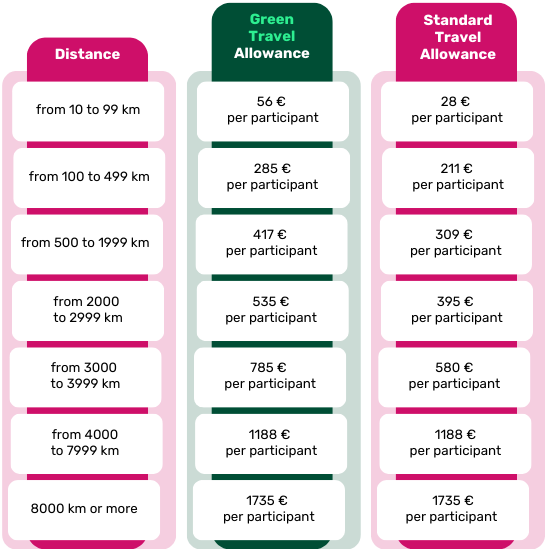
Travel costs for participants
Individual support to participants with fewer opportunitiesMobility participants who will be qualified as fewer opportunities participants include:

These groups of students are allowed to receive a top-up inclusion grant of 250 EUR per month as well as a travel support (in case of travelling for short-term mobility to EU country and non-EU country or in case of long-term mobility to non-EU country).
Inclusion grant
For mobility participants that come from disadvantaged groups e.g. disabled persons, there is a possibility to apply for additional support which is necessary in order to carry out their mobility abroad i.e. to cover the cost of stay and travel of personal assistant, purchase of specialized equipment to facilitate mobility etc. This is based on a special application form, submitted to Program National Agency by the Home University Coordinator, against the real costs that have been incurred by the mobility participant. More details regulating the payment of inclusion grant are available here.
Travel days - regulations
Students participating in mobility under the Erasmus+ programme may receive financial support for travel days, provided that the travel days are not included in the activity period, i.e., they do not overlap with the dates specified in Learning Agreement (the actual dates of the stay at the host institution). In justified cases, participants are entitled to individual support to cover subsistence costs before the start and after the end of the activity, based on the daily unit costs defined for individual support.
The number of eligible travel days depends on the mode of transport chosen:
- Standard travel – participants may receive individual support for up to 2 travel days (1 day before and 1 day after the activity).
- Green travel – participants may receive individual support for up to 6 travel days, due to the potentially longer duration of sustainable travel (e.g. by train, bus, carpooling).
The declaration regarding travel days must be submitted to the Academic Mobility Coordinator.
-
Shortening of mobility and force majeure
Shortening the mobility may require the return of part or all of the grant received. Erasmus+ grant can be obtained only for the period that has actually been spent at a host university abroad, confirmed in writing by the host university. A student who has been staying physically at a host university for less than 2 months will be required to return the entire scholarship received. If the student starts their mobility 5 days before then initially planned date in LA or in the Erasmus grant contract or finishes their mobility up to 5 days after the initial end date, the amount of the grant received remains unchanged.
Please note that the minimum period of stay abroad required to claim an Erasmus grant is 2 months. Shortening the stay requires the return of a part of the scholarship, because the scholarship can be obtained only for the period actually spent at the partner university abroad (in accordance with the contract signed before departure and a certificate of stay brought from a host university).
Shortening of mobility – force majeure – in case a student undergoes a serious accident abroad or is seriously ill, it is possible to shorten the stay due to the so-called 'Force majeure' case which is independent of the student. In this case, the student should immediately contact the International Office (room 206).For more details about ‘Force majeure’ case, please read:
Extension of mobility
Extension of mobility (within one academic year) is possible only if the university has unused funds from the Erasmus+ budget. In order to apply for extension of mobility, the WSB University student needs to apply to our Academic Mobility Coordinator (gweglarz@wsb.edu.pl) with an application for extending the stay abroad (provide exact dates of the planned stay and justification). The application must be accompanied by a certificate from the partner university on accepting admission for the summer semester and the Online Learning Agreement proposal for the next period.
The application must be submitted to the International Office (room 206) no later than a month before the ending date of the current semester according to the financial agreement.
Attention! An application will not be considered unless it states the exact dates of extended mobility. The exact dates are obligatory to mention while applying for additional funding. The approval for extension of mobility can be withdrawn if the student does not settle financial and academic matters of the previous semester.
-
All Erasmus+ program participants (studies or traineeships) have the opportunity to complete a language proficiency test before their mobility and participate in online language courses available on the EU Academy platform.
The OLS (Online Linguistic Support) system was developed with Erasmus+ participants in mind to help them improve their language skills needed for undertaking a traineeship or studying abroad.
Participants going abroad under the Erasmus+ program can assess their language proficiency using the OLS system, which will help them evaluate the language they will use during their studies or traineeship and gain access to a personalized language learning path.
The language assessment before departure is optional for students participating in a mobility lasting at least 14 days. The aim is to ensure that students have mastered the language to the level recommended by the host organization. Exceptions are possible for individuals whose native language is the one in question or in duly justified cases. The results of the language assessment do not prevent participation in the Erasmus+ program.
Participants interested in improving their language skills can take part in online language courses before or during their stay abroad. Access to language courses includes various interactive and personalized training sessions. Participants can take language courses in any language available in the language support system.
-
Maximize your Erasmus+ Journey by logging in! Benefit from comprehensive guidance and information throughout your mobility — before, during, and after your exchange.
Discover a wealth of tips, stories, and exclusive deals from fellow students and organizations in public feed.
Brought to you by the European Commission as part of the European Student Card Initiative, the app simplifies administrative procedures, making your student mobility experience easy.